Treatment of Generalised Exfoliative Red Dermatitis due to Gastric Malignancy with a Neoadjuvant Chemotherapy Regimen
By Ailing Li, Yawen Shi, Xiaoxiao WeiAffiliations
doi: 10.29271/jcpsp.2025.12.1643
Sir,
Exfoliative red dermatitis (ERD) is a serious dermatological condition with multiple underlying causes, including the possibility of an associated occult visceral malignancy.1 ERD presents as an inflammatory state of the skin, with associated skin barrier and metabolic dysfunction. ERD may be congenital, of acute onset, or may develop progressively from underlying primary lesions, including malignancy.2 It is an inflammatory dermatological condition that causes widespread erythema and desquamation of the skin, with lesions covering ≥90% of the body surface area, and studies have shown that ERD is strongly associated with malignancy.3
A 57-year man presented to the hospital with intermittent epigastric pain and emaciation for more than 3 months, which had aggravated over the past week. Physical examination showed pain in the epigastric region on deep pressure. Abdo- minal CT examination showed uneven thickening of the gastric wall (suggestive of a malignant gastric tumour), multiple enlarged lymph nodes around the stomach and adjacent to the abdominal aorta (suggestive of metastasis), abnormal density shadows in bilateral adrenal glands (also suggestive of meta- stasis), and the presence of pelvic effusion (Figure 1A). Histopathology showed a malignant gastric tumour, comprising poorly differentiated adenocarcinoma (Figure 1B). Immunohistochemical staining showed Ki-67 (+) 65%, Her-2 (-), CK8/18 (+), CK5/6 (-), Villin (+), leucocyte common antigen (-), chromogranin A (-), synaptophysin (-), CD56 (-), CD3 (-), and CD20 (-). Based on the diagnosis and comprehensive analysis of the patient's condition, the treatment plan included Sindilizumab, Oxaliplatin, and Tigio, along with medications to protect the gastrointestinal mucosa, anticoagulation, and other treatments. The treatment process went smoothly, and he was discharged from the hospital to recuperate and continued to take an oral Tigio capsule to complete the current cycle of treatment after discharge.
Ten days prior to admission, the patient developed small, nail cap-sized erythematous lesions on the trunk and limbs, accompanied by noticeable itching. Upon visiting this hospital, the initial diagnosis was a drug-induced rash. The patient was advised to temporarily discontinue chemotherapy and was prescribed oral loratadine. However, the rash did not improve, and the itching persisted.
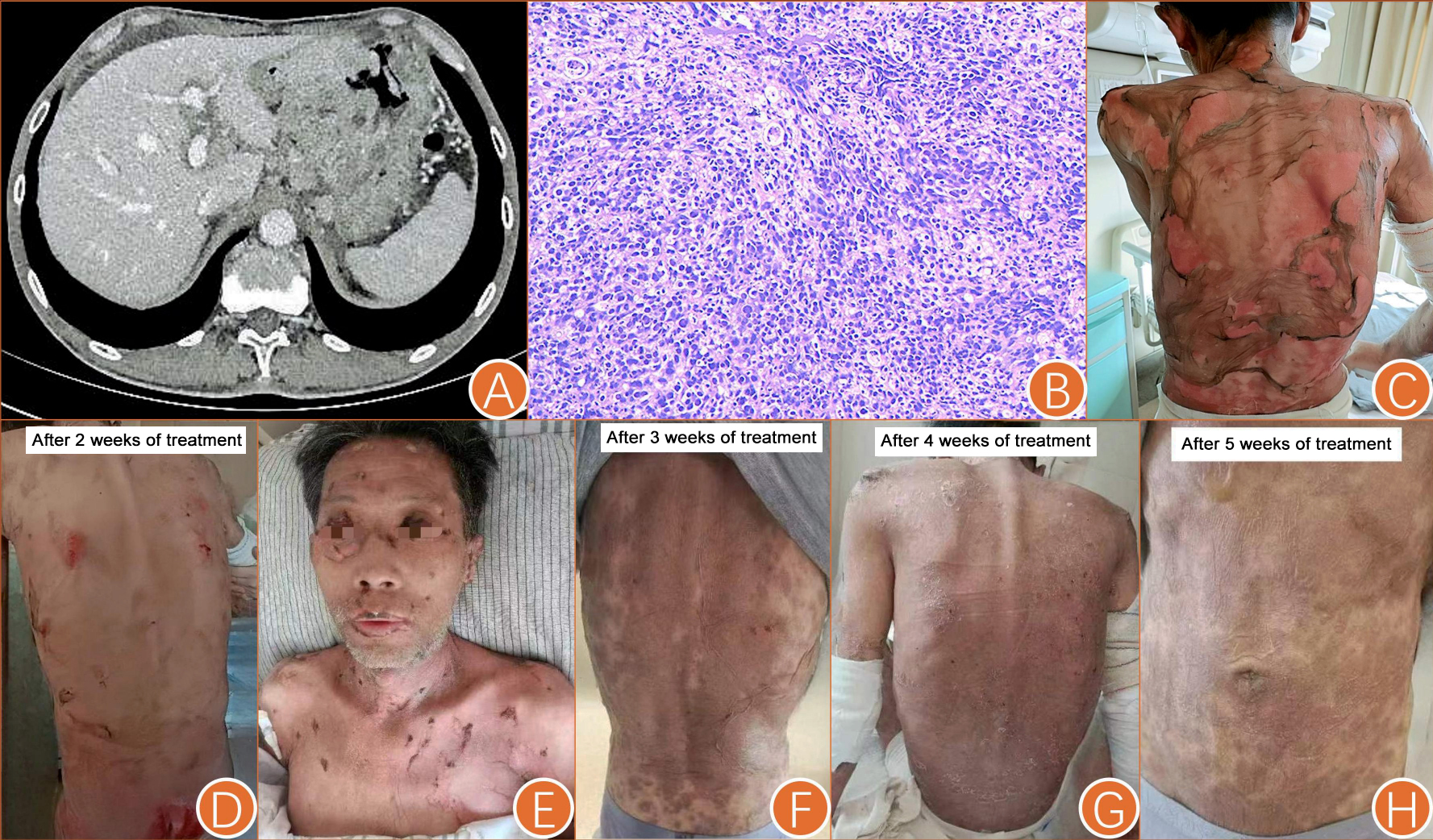 Figure 1: (A) Abdominal CT scan showing uneven gastric wall thickening, multiple enlarged lymph nodes around the stomach and adjacent to the abdominal aorta, abnormal bilateral adrenal gland densities, and pelvic effusion. (B) Histopathology showing poorly differentiated gastric adenocarcinoma. (C) Erythematous lesions on the back with blisters and erosions. (D, E) Two weeks after treatment. (F) Three weeks after treatment. (G) Four weeks after treatment. (H) Five weeks after treatment.
Three days before admission, the erythematous lesions on the trunk and limbs rapidly increased in size and number. Larger, walnut-sized blisters appeared, characterised by thin, flaccid walls that ruptured easily and contained clear fluid. The epidermis overlying the lesions was loose and peeled, causing pain and discomfort (Figure 1C). Similar erythema, vesicles, and oozing were observed on the eyelids, lips, oral mucosa, external auditory canals, and auricles.
Based on the clinical presentation and progression, the patient was diagnosed with generalised ERD. Treatment included glucocorticoids for anti-inflammatory and anti-allergic effects, intravenous levofloxacin for infection control, correction of water, electrolyte, and acid-base imbalances, as well as nutritional support and enhanced skin care.
The patient’s condition gradually improved, as shown in follow-up images taken at two weeks (Figure 1D and E), three weeks (Figure 1F), four weeks (Figure 1G), and five weeks (Figure 1H) after the initiation of the treatment. Ongoing follow-ups were conducted to monitor further changes in the patient's condition.
In conclusion, clinicians should remain vigilant for the occurrence of generalised ERD when using the chemotherapy regimens such as Sindilizumab, Oxaliplatin, and Tigio. The skin is a very important protective barrier for the human body, and when generalised ERD develops, the chemotherapy medicines should be stopped first, followed by prompt symptomatic treatment to minimise skin damage.
COMPETING INTEREST:
The authors declared no conflict of interest.
AUTHORS’ CONTRIBUTION:
AL: Drafted, revised, and edited the manuscript.
YS: Collected data, conducted data analysis and interpretation.
XW: Collected the data.
All the authors approved the final version of the manuscript to be published.
REFERENCES
- Plachouri KM, Georgiou S. Paraneoplastic erythroderma: An insight on the existing data. Int J Dermatol 2020; 59(12): 1429-36. doi: 10.1111/ijd.14970.
- Tso S, Satchwell F, Moiz H, Hari T, Dhariwal S, Barlow R, et al. Erythroderma (exfoliative dermatitis). Part 1: Underlying causes, clinical presentation and pathogenesis. Clin Exp Dermatol 2021; 46(6):1001-10. doi: 10.1111/ced.14625.
- Long V, Choi EC, Zhaojin C, Ganesegaran TS, Zhun Rui M, Yong AMY, et al. Malignancy-associated generalised exfoliative dermatitis: A retrospective study in a single-centre Asian cohort. Australas J Dermatol 2023; 64(2): e152-9. doi: 10.1111/ajd.13987.