Primary Hepatic Neuroendocrine Tumour Misdiagnosed as Liver Metastases of Lung Adenocarcinoma: A Rare Case
By Junzi Liu, Long Ye, Qiyu LiuAffiliations
doi: 10.29271/jcpsp.2025.12.1641Sir,
Primary hepatic neuroendocrine tumours (PHNETs) are exceptionally rare neoplasms, originating from neuroendocrine cells.1 In contrast to the relatively common metastatic hepatic neuroendocrine tumours (NETs) from the gastrointestinal tract, PHNETs are frequently misdiagnosed in clinical practice. Herein, we present a rare case initially misinterpreted as hepatic metastases of lung adenocarcinoma.
A male patient was admitted on May 26, 2024, with persistent cough. The CT scan revealed tumours in the right lung and liver (Figure 1A, B). Pathologic and immunohistochemical analysis of lung tissue suggested lung adenocarcinoma, supporting a preliminary diagnosis of lung adenocarcinoma with hepatic metastases. Notably, serum neuron-specific enolase (NSE) was significantly elevated (>740.00 ng/mL; normal: <16.50 ng/mL). Following a gastroenterology consultation, a CT-guided liver biopsy was performed on July 1, demonstrating the following profile: P-CK (-), CK7 (-), TTF-1 (-), Napsin A (-), P40 (-), CK5/6 (-), P63 (-), SMARCA4 (+), CD56 (+), chromogranin A (CgA) (+), synaptophysin (Syn) (+), Ki-67 (+, about 20%) (Figure 1F-J). When the CT scan and gastrointestinal endoscopy ruled out extrahepatic NETs, a comprehensive analysis of imaging, pathology, and clinical features ultimately confirmed grade 3 (G3) PHNETs. To reconfirm the result, Ga-68 DOTATATE scan was recommended; however, the patient declined the examination due to financial constraints. On July 11, the patient initiated two cycles of chemotherapy and immunotherapy (etoposide 140 mg, carboplatin 0.4 g, toripalimab 200 mg, and octreotide acetate microspheres 20 mg). The follow-up CT on September 14 reported disease progression (Figure 1C and D). Transarterial chemoembolisation was deferred due to declining haemoglobin (78 g/L). Unfortunately, the patient passed away two months later.
Although the incidence of NETs has risen over the past three decades, which is likely due to improved diagnostic awareness, PHNETs remain exceedingly rare, comprising only 0.8%–4.0% of all NETs.2 Their radiologic similarity to primary/metastatic liver tumours often leads to misdiagnosis. Key discriminants in this case included: first, the solitary cystic-solid mass with predominant hepatic arterial supply (Figure E) aligns with prior reports;2,3 Second, negative AFP/CEA and elevated NSE supported NET diagnosis and prognostication;2 Finally, G3 NETs (synonymous with poorly differentiated neuroendocrine carcinomas [NEC]) exhibit diffuse Syn and CgA expression, nuclear atypia, focal necrosis, and high mitotic rates (>20/10 HPF).1,3
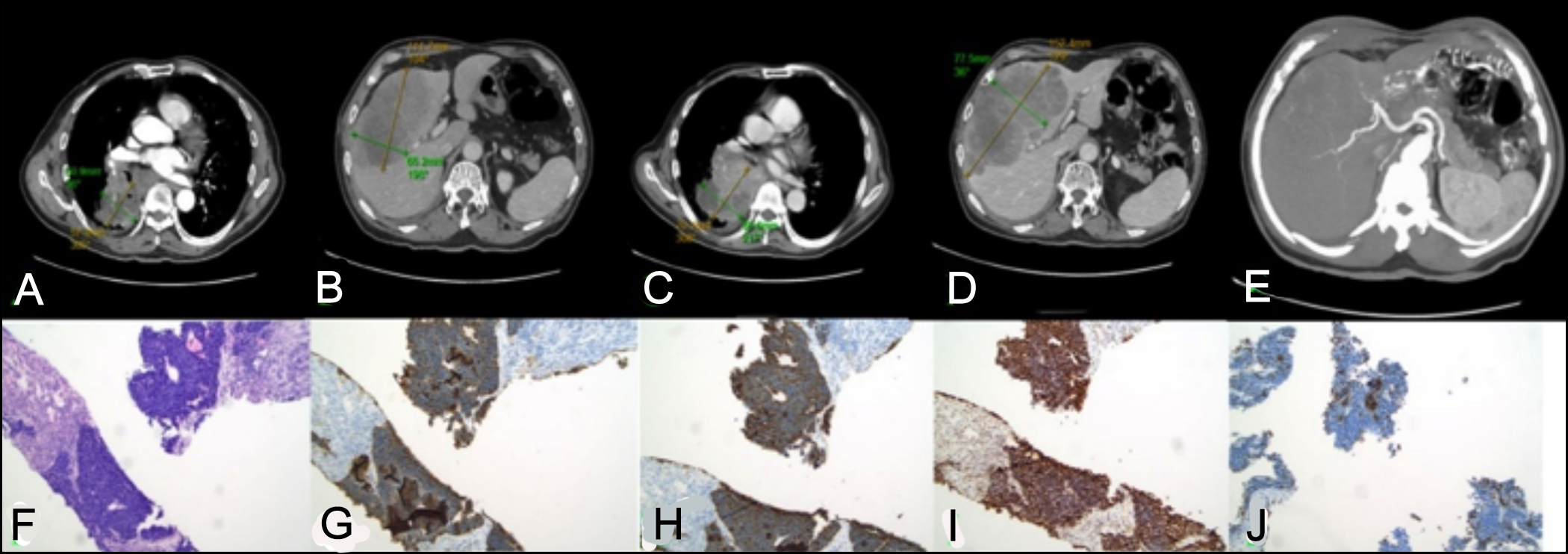 Figure 1: (A, B) Chest and abdominal contrast-enhanced CT on May 26, 2024, showing an approximately 5.7 × 5.1 cm mass in the right lung lobe (arterial phase) and an approximately 11.2 × 6.6 cm mass in the liver (portal phase). (C, D) Follow-up CT on September 14, 2024, demonstrating enlargement of both tumours. (E) Maximum intensity projection (MIP) indicating hepatic arterial supply to the hepatic mass. (F) Histopathological microscopy showing abnormal cellular proliferation. (G-J) Immunohistochemical results demonstrating positive staining for CgA, Syn, SMARCA4, with a Ki-67 ratio of approximately 20%.
Definitive PHNETs diagnosis requires exhaustive exclusion of extrahepatic primaries via imaging, immunohistochemistry, and longitudinal follow-up. Therapeutic options, such as surgery, chemoradiotherapy, chemoembolisation, and peptide receptor radionuclide therapy, lack standardisation. However, the above treatment options exhibit limited effectiveness for NEC, with most patients experiencing relapse after surgery. Therefore, formulating appropriate treatment remains a meaningful and significant clinical challenge.1,2 Surgical resection is generally considered beneficial for most patients.2,4,5 The difficulty in diagnosis inevitably affects the treatment strategy of PHNETs. Further research is required to determine whether this will have an impact on the treatment efficacy.
In conclusion, this rare case underscores the diagnostic challenge posed by synchronous lung adenocarcinoma and PHNETs. Multidisciplinary integration of imaging, serology, and histopathology is critical to distinguish PHNETs from metastases and guide timely intervention. When liver metastasis is disproportionate to the primary lesion, clinicians should promptly perform biopsy and immunohistochemical examination to determine the origin of the liver lesion, facilitating early surgical intervention, if feasible.
COMPETING INTEREST:
The authors declared no conflict of interest.
AUTHORS’ CONTRIBUTION:
JL: Drafted and edited the manuscript.
LY: Collected and modified the data.
QL: Conceptualised and revised the study.
All authors approved the final version of the manuscript to be published.
REFERENCES
- Xia Y, Zhang L, Wu H, Qiao L, Xia L. Primary hepatic neuro-endocrine tumour with multiple liver metastases: A case report with literature review. J Int Med Res 2020; 48(6): 300060520932114. doi: 10.1177/0300060520932114.
- Yang XR, Li YL, Li ZY, Chai XM. Primary hepatic neuro-endocrine neoplasms: Imaging characteristics and misdiagnosis analysis. Front Oncol 2024; 14:1391663. doi: 10.3389/fonc.2024.1391663.
- Wang LX, Liu K, Lin GW, Jiang T. Primary hepatic neuro-endocrine tumours: comparing CT and MRI features with pathology. Cancer Imaging 2015; 15(1):13. doi: 10.1186/ s40644-015-0046-0.
- Zhang Z, Li H. Surgical treatment of primary hepatic neuroendocrine tumour diagnosed by Al18F-NOTA-Octreotide PET/CT: A case report. Front Med (Lausanne) 2023; 10:1256 176. doi: 10.3389/fmed.2023.1256176.
- Seki Y, Sakata H, Uekusa T, Momose H, Yoneyama S, Hidemura A, et al. Primary hepatic neuroendocrine carci-noma diagnosed by needle biopsy: A case report. Surg Case Rep 2021; 7(1):236. doi: 10.1186/s40792-021-01315-3.